
Maruthanamadam
Maruthanamadam Anjaneyar Temple
A roadside Hanuman temple north of Jaffna town — home to one of the largest open-air Anjaneyar statues in Sri Lanka.
November to March; Tuesdays and Saturdays for fullest atmosphere
Best time to visit
6 a.m. – 12 p.m. and 4 p.m. – 8 p.m. daily
Opening hours
Free; donations welcomed
Entrance fee
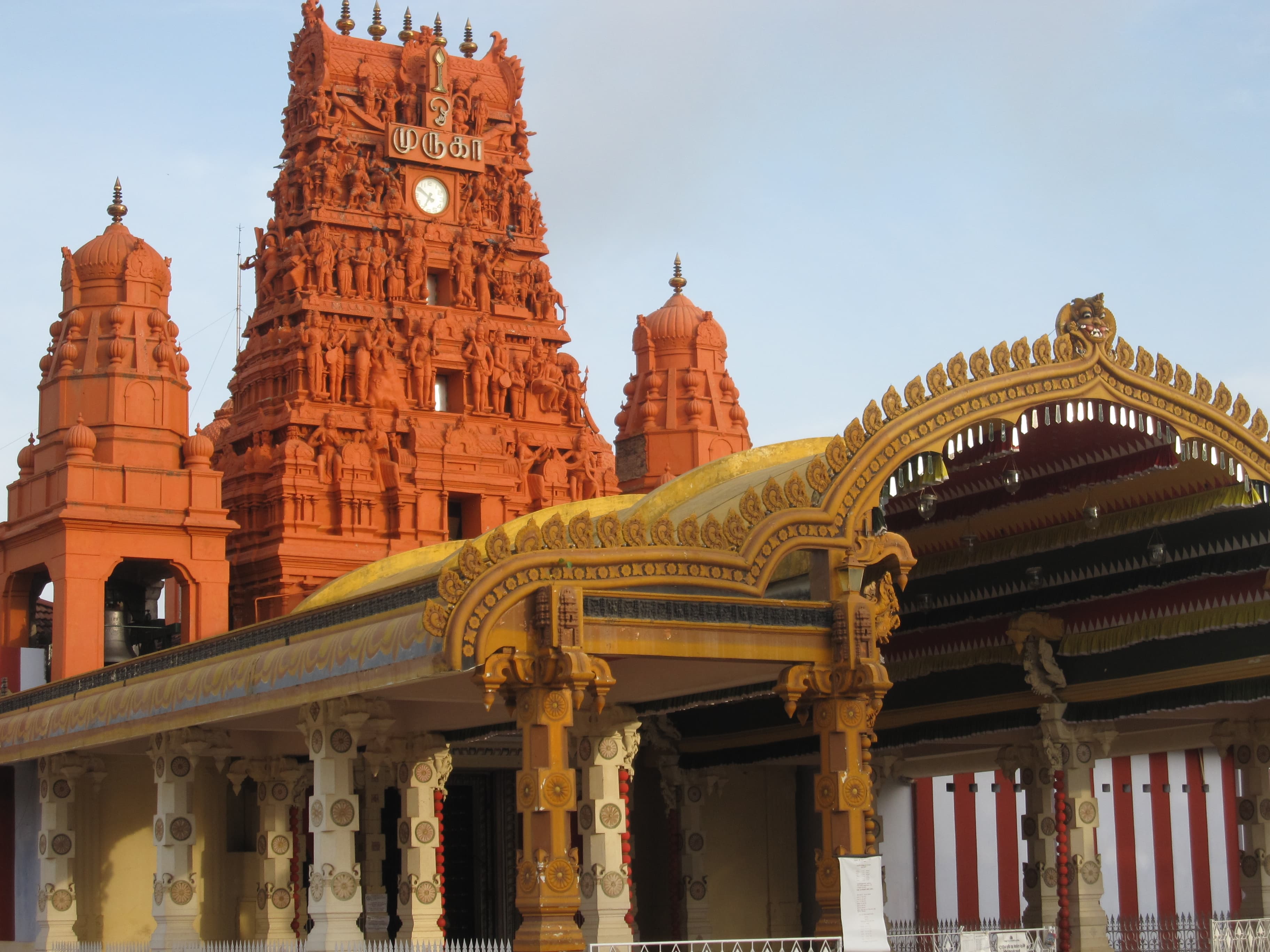
Maruthanamadam Anjaneyar Kovil stands beside the main road between Jaffna town and the northern coast, in the village of Maruthanamadam, around seven kilometres from the centre. It is dedicated to Anjaneyar — the Tamil name for Hanuman, the monkey-form deity of the Ramayana, devoted servant of Rama — and is one of the principal Hanuman temples of the North. The site has been a place of worship for at least a century in its current form, and the temple's reputation has grown steadily since the addition of a large open-air Anjaneyar murti in the late twentieth century — among the largest of its kind in Sri Lanka, visible from the road as one drives past.
The temple precinct is small by the standards of the great Saiva shrines of the peninsula. The inner sanctum holds the principal Anjaneyar deity in standing form; the outer prakara holds subsidiary shrines including those of Rama and Sita, Lord Shiva, and the navagraha. A flagstaff (kodimaram) faces the main shrine in the conventional arrangement. The architectural vocabulary is South Indian Dravidian; the open-air statue, in painted concrete, is an act of modern devotion rather than ancient construction.
Within the broader Tamil Vaishnava and Saiva landscape, Anjaneyar is associated particularly with strength, protection in travel, and the warding off of malign planetary influences — the "Sani parihara" rituals performed for those passing through difficult astrological periods are a regular feature of the temple's working week. Tuesdays and Saturdays draw the largest weekday crowds. The annual Hanuman Jayanthi observance, in the Tamil month of Margazhi (December–January), is the temple's principal festival; oil lamps are lit in long rows along the prakara, and devotees offer butter, betel leaves, and vadai garlands.
For the visitor, Maruthanamadam is most easily taken as a brief stop on the way to Keerimalai, Maviddapuram, or Tellippalai — twenty minutes is enough for a full circumambulation and a quiet pause at the inner sanctum. The roadside location and the visibility of the open-air statue mean it is rarely missed by drivers heading north, and there is parking on the verge for two or three vehicles.
The temple is straightforward to combine with the larger circuit of the northern coast: Maruthanamadam, Tellippalai Durga Devi Kovil two kilometres further on, then Maviddapuram, Keerimalai, and Naguleswaram makes a satisfying half-day arc through the heartland of Jaffna's Hindu sacred geography.
What to know
Visiting quietly
- Best season
- November to March
- Etiquette
- Cover shoulders and knees. Shoes off at the outer gate. Photography of the open-air statue is fine; do not photograph rituals inside the sanctum.
- Getting there
- 20 minutes from Jaffna town by road
A closer look
Location
On the map
Featured in these tours
Visit on a curated journey
4-6 hours
Private Jaffna City, Temples & Local Life Tour
A gentle, story-rich introduction to Jaffna through temples, markets, colonial history, Tamil culture, and local food stops.
See the tour →
7-8 hours
Northern Coast Temples, Springs & Beaches Tour
A full-day private coastal route linking sacred kovils, sea springs, Buddhist heritage, quiet beaches, and the northern shoreline.
See the tour →

Practical things
Frequently asked
Who is Anjaneyar?
What is the open-air statue at Maruthanamadam?
How long does a visit take?
Planning a visit to Maruthanamadam Anjaneyar Temple?
Begin a quiet conversation
Enquire about an Abbiholiday villa nearby and Abbi will help you plan your trip to the North.
We reply within 24 hours, usually within a few hours.Your enquiry comes straight to Abbi's inbox.